
A Meaningful Article
BUT... "The meaning crisis has been cancelled."

Very few people, if any, will be interested in what I did last Saturday. My activities, including writing this article, were for myself. However, sharing publicly makes this a tad more meaningful and creates a tiny ripple that may impact someone somewhere.
I read an article I had saved: Meaning: lost, or muddled by metaphysics? by David Chapman and Andrew Conner - Apr 28, 2026
I read the related essay: Is the "meaning crisis" a real loss? by Andrew Conner - Apr 17, 2026
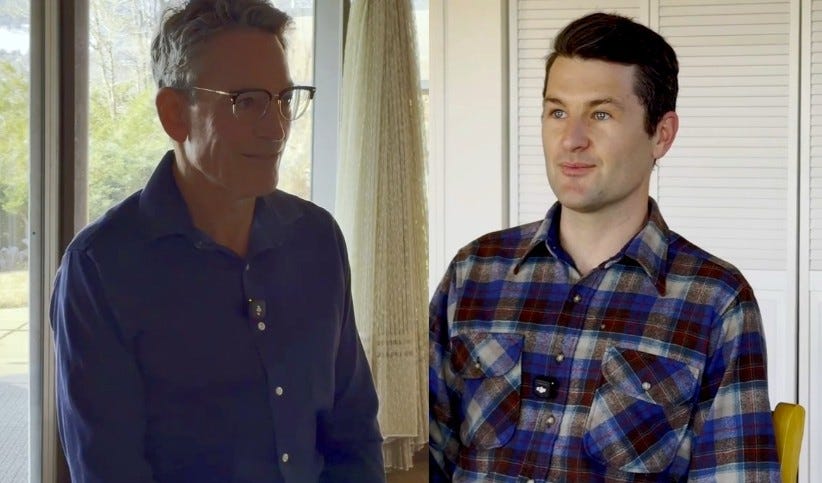
And I watched the related video embedded at the top of their article.
Before commenting on this content, I will explain why this is of interest to me. A page on my website, I Love Surfing the Web - 2019, captures part of the story. I listed some of my favorite teachers at that time. One of these was David Chapman and his Meaningness website where I had spent many hours. 2019 was a pivotal year for me as I discovered new teachers, one of them being John Vervaeke.
The content I explored on Saturday was the comparison and contrast of the ideas of David Chapman and John Vervaeke regarding meaning and the meaning crisis through the analysis of Andrew Conner.
For me, tone is important and I am put off by the widespread ugliness of engagement with ideas in society today. Chapman and Conner were a pleasure to watch, very respectful of Vervaeke. And they were pleasant, lots of smiles and laughter.
I will now capture my thoughts as I riff on the essay by Andrew Conner.
@Meaningness and @DrJohnVervaeke are the two most important thinkers I’ve found on questions of meaning. Vervaeke thinks we’ve lost something essential and need to rebuild it. Chapman thinks nothing was lost, we’ve just piled 2,600 years of philosophical garbage on top of a way of being that’s still right here.
I agree. However, all thinkers have incomplete views and I will point to a couple of additional voices later. Importantly, neither Chapman nor Vervaeke claim to have all the answers and they themselves have changed over time.
Conner does an excellent job of summarizing Vervaeke and Chapman.
We now understand the rough shape of both of their views. Now, the interplay gets interesting. Their diagnostic overlap is large and, honestly, unsurprising. People are noticing that modern life feels empty and looking for solutions. Even though their solution views are quite different, they conceptually touch each other many times.
In my online community, WE appreciate such differences without conflict.
And, personally, my life feels full, no crisis for me. But I am aware of the growing numbers of deaths of dispair. Modern life is lived in a civilization that is in big trouble.
So Chapman and Vervaeke start with a similar observation, diverge radically in diagnosis, meet in unison at times (example: relevance realization and the frame problem), diverge again, and end up not too far apart.
Nice.
There’s a sharper Chapman critique of DIME itself, which he raised directly in our conversation. DIME’s ingredients (dialogical, imaginal, mindful, embodied) are axial age practices. They’re the tools developed by the very cultures that first felt the separation between the here and the divine. If they didn’t resolve the separation then, why would they now? The practices may still be worth doing, but presenting them as the rebuild kit for what was lost assumes they once did the rebuilding. They didn’t. They were the axial age’s attempt to cope with a problem it had just introduced.
Chapman’s critique makes good sense to me.
Another way of viewing them is through a developmental lens. Vervaeke is offering a stage-3-to-4 transition tool: take on a system, re-author yourself through it, become a self that can hold meaning. A diagnosis of what happened to appease your mind, and a cluster of self-correcting practices that inflate a structure where meaning arises. Within this, the meaning itself may be nebulous, but we need to author ourselves to inflate a container for it to arise in. Vervaeke’s solution is architectural — we’re engineering, “reverse engineering enlightenment”. The right design can address the problem.
Chapman’s solution is recognitional. He’s writing from stage 5 — the meta-systematic view, where any specific system (DIME, Vajrayana, anything) is seen as contextually useful rather than ultimately true. Drop fixation and denial, notice how the confused stances aren’t tenable. There’s nothing to build, just clear away what obscures.
Vervaeke offers a story and system. Chapman wants you to see the gaps between systems.
Again, nice. And making a metamodern move, my approach is not either Chapman or Vervaeke but both Chapman and Vervaeke and others, many others which Conner seems unaware of. I was not familiar with Andrew Conner but his open-mindedness impressed me.
Chapman has a lot of good content on his website discussing Meaning and meaninglessness.
On one of his other websites, Chapman has good content discussing adult development and stage theory: Developing ethical, social, and cognitive competence. One section in particular, The fluid mode (stage 5), Published October 12th, 2015, will probably feel quite familiar to Metamodern Wannabes. Chapman is one of many reasons to get outside of the metamodern bubble.
Last year Emil Ejner Friis wrote something that has stuck in my mind.
The meaning crisis has been cancelled. If you can’t find meaning in the midst of a fascist takeover, in a world on the brink of another world war, while an emerging techno feudal oligarchy stands ready to stamp on a human face for-ever, you’ll never find meaning in anything.
One question remains, however:
Is the liminal space, or whatever we should call it, just another toothless meditation club sprinkled with a little intellectual masturbation on top, or, is it a slumbering tiger with immense potential for societal transformation just waiting to be unleashed onto history. I’m curious to find out. Maybe the yoga bourgeoisie actually got some teeth after all.
I too am curious but no longer waiting. I no longer see the SPACE as a source of societal transformation. However, personally, my life remains meaningful.
I have written an article for our other Substack, Final Wa𝒊ve Feminism. However, Women Matter #1- Rebecca Newberger Goldstein has not yet been published and I will link to it later. Goldstein has lots to say about what makes our lives meaningful and why it is so in her recent book, The Mattering Instinct - How Our Deepest Longing Drives Us and Divides Us.
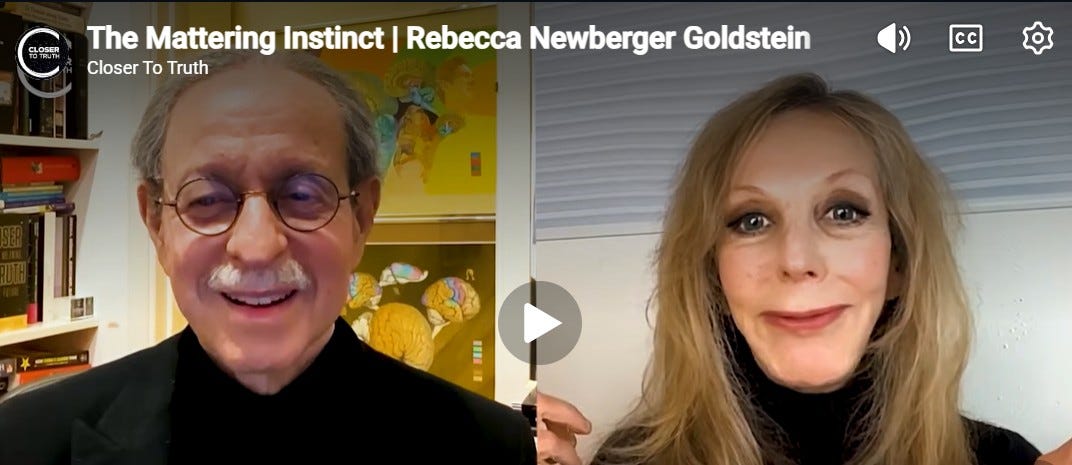
Another excellent resource outside of the metamodern bubble is Closer to Truth hosted by Robert Lawrence Kuhn. Relevant to this article is the Search for Meaning section. Kuhn and Goldstein discuss her book, The Mattering Instinct and I would again like to point out the wonderful tone of their conversation.
Lastly, for now, I will link to my already out of date essay About What Matters, posted December 29, 2023.