
"...it’s about damn time."
AMPLIFY!

This article is better suited for a new Substack that I hope WE will launch soon.
Alice Wild tells us that White Women Are the New ‘Problem’ and I agree.
I’ve never been one to ‘slot myself’ into one political label. I have found politics to be a minefield of hate and horrific power-abuse… but that’s also likely because I was conditioned into silence, and baptized into the great depths of Christian Nationalism… But no mater the label, I will always adamantly protest systems of control, oppression and abuse—and radically amplify the light in the voices of other women and those who have experienced abuse. I will always speak to feminine truths and spread the message of human value, safety and love.
Conclusion—reclamation
So, yes: white liberal women ARE a problem, and it’s about damn time.
We have been historically used—mind, body, soul, and spirit—as supply for the patriarchy. And so have many other marginalized groups. Together, we share our pain, our humanity, our voices. And this administration seems to have realized that their plan isn’t working quite as well as they expected: uniting the nation against “the enemy within.” White liberal women see through the cracks, and we’re finally safe enough to name them with a shared outcry.
Alice Wild is a voice that I would like to amplify.
Katie Jagielnicka tells us that Men Are Not More Rational. They Are Just More Powerful.
This is the ancient playbook of patriarchal power. Whatever women say, especially when they speak of the harm done to them by men, can be dismissed as hysterical, hormonal, irrational, the erratic byproduct of their supposedly ‘defective’ biology. Meanwhile, men pat each other on the back, reassuring one another with the confidence of those certain they embody reason itself. Men are rational, women are emotional.
Or so the story goes, repeated over and over and over again.
Modern neuroscience and psychology, too, consistently tell us that the split between reason and emotion is a false dichotomy.
There is so much more to say about about this.
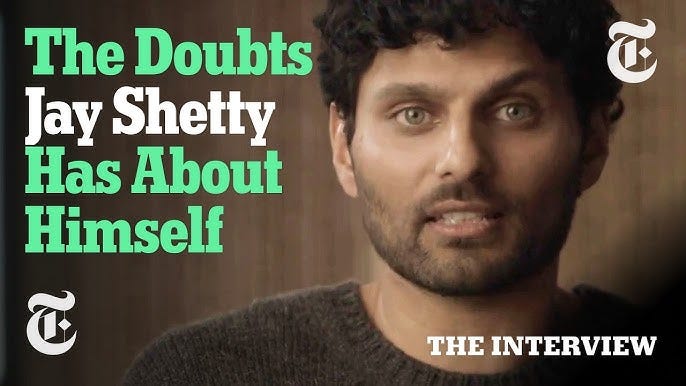
And Liz Bucar points to an important dynamic: Jay Shetty Knows Exactly What You Want. That’s the Problem.
Millions of people experience Shetty as a spiritual leader. Millions of people find something genuinely meaningful in his content.
We are hungry. That’s the truth underneath all of this. Hungry for meaning, for practices that connect us to something larger than optimizing our morning routines, for teachers who seem to embody a different way of moving through the world. That hunger is not going anywhere.
What Shetty is very, very good at is sensing that hunger and offering something that feels like it addresses it without requiring very much in return. No tradition to wrestle with. No community to be accountable to. No practices that might genuinely cost you something. Just the beautiful thing of dipping your toe in.
Freya India has a book for us: GIRLS®: Gen Z and the Commodification of Everything
But it’s not just for girls and young women. It’s for parents, grandparents, aunts, uncles, teachers, anyone who cares about what happened to my generation and how to protect the next. If you’re a father of girls wondering what Facetune is, a teenager sick of being bombarded with BetterHelp ads, or a young man wondering why so many women have lurched to the left politically, I hope this book will help.
Celeste Davis wants to change the Epstein conversation and she has some tough questions.
Everyone is asking how did these men get away with so much rape?
No one is asking what would cause so many to want to rape so much in the first place?
Why aren’t we talking about why so many men when given power continually choose to use that power to rape women?
Finally, for now, I want to amplify an essay by Elizabeth Oldfield.
Summary
What would it mean to build a feminism not around the freedom of the individual, but around our irreducible need for each other? I live in a household of eight people—and it was loneliness, not liberation, that brought us together. Starting from that experience, I want to argue that both dominant strands of feminism—the ‘liberal’ drive to free women from care, and the ‘conservative’ insistence that care is women’s defining vocation—fail us in the same fundamental way. They cannot hold the truth of multiple things at once. Care is not a trap, nor is it a destiny. It is the connective tissue of a common life. What we need—whether we are men, women or people who struggle with those labels—is not to shrug off our interdependence, but to create better ways of being entangled with each other—a feminism grounded, as bell hooks puts it, in the practice of love.
I pay very little attention to my stats. However, I note that after peaking at 140 subscribers, I am now down to 132. My top post is April 16, 2025 - Writing to my future self