
Iain McGilchrist
an interesting man with interesting ideas

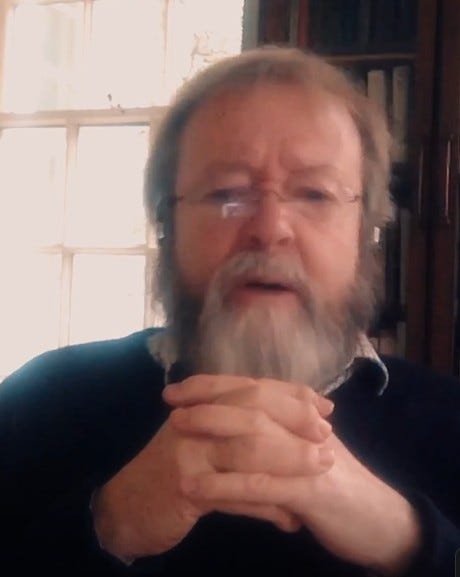
There is far more on my mind than what I can capture in writing. So it often is with me. So it probably is with most people most of the time.
Lately, what has been on my mind is Iain McGilchrist and the right brain left brain narrative. While exercising on my treadmill I have been listening to podcasts by Decoding the Gurus that I felt deserving of my attention. Although I subscribe to this channel I rarely listen to the content it offers.
Decoding the Gurus is a popular podcast that takes a skeptical, analytical look at the "secular gurus" and intellectual contrarians who dominate the modern media landscape. Hosted by Chris Kavanagh, a cognitive anthropologist, and Matthew Browne, a psychologist, the show examines figures who often present themselves as alternative truth-tellers on topics ranging from science and politics to self-improvement.
Iain McGilchrist, Part 1: Right-Brain Thinking
In this episode, we take a journey into the mind, traversing both the left and right hemispheres, but mostly the left, as we engage with the truly mind-bending insights of British psychiatrist-philosopher-neuroscientist-theologian-author Iain McGilchrist. Best known for his 2009 book "The Master and His Emissary: The Divided Brain and the Making of the Western World" but also a much lauded academic and sensemaker.
Iain McGilchrist, Part 2: Hemispheres, Culture, and Cosmic Consciousness
In this episode, we return to Iain McGilchrist as he spirals upwards from his binary hemispheric model into full cosmic spirituality. The rule is simple: everything McGilchrist likes is due to the subtle, nuanced, and deeply sophisticated right brain, while the left brain (pffft) is responsible for reductionism, modernity, and most of the problems in your life.
From this neuroscientific foundation, the theory expands with admirable ambition. Civilisations rise and fall depending on which hemisphere they inhabit. Ancient societies were properly attuned to the right brain, while the modern world has gone mechanical and spiritually bankrupt. The details are, of course, very complex, but the moral is clear.
Scientific evidence features occasionally, mostly in a decorative capacity or as parables of scientists being baffled by mystical forces. Hence, we learn that decapitated worms retain perfect memories, Nobel Prizes have been awarded for demonstrating a mystical direction powering evolution, and near-death experiences establish that memories form when the brain isn't functioning.
Alongside this hard science, McGilchrist also ventures into more spiritual realms, where we learn that artificial intelligence is likely to be channelling demons, schizophrenia might be caused by malign spiritual forces treating our brains as a luxury resort, and recently exorcised demons prefer to communicate via text message. No really...
Ultimately, what matters is that McGilchrist's bespoke theology, bespoke metaphysics, bespoke biological teleology, and bespoke panentheist philosophy are really very impressive. And if you don't find any of it compelling, well, we are sad to inform you that this itself proves you are stuck in the wrong mode of thinking and failing to recognise true profundity.
And if that doesn't work, then let's just say it was all a metaphor anyway!
A couple of years ago I did a deep dive into the Iain McGilchrist. I probably have more respect for him than Chris Kavanagh and Matthew Browne. However, I think they raise many valid questions that are well worth considering.
Personally, I like the metamodern adage: After deconstruction, reconstruction. It seems to me that Decoding the Gurus is very good at deconstruction but not much interested in reconstruction. And it seems to me that their deconstruction of Iain McGilchrist is very good.
For reference, I captured my deep dive into this interesting man with interesting ideas in writing.
About Iain McGilchrist - Part 1, posted February 27, 2024
About Iain McGilchrist - Part 2, posted March 17, 2024
I do not expect anyone to follow me down this rabbit hole. However, as I reread my essays, a few ideas that I expressed are more meaning today than they were two years ago. Now I do want to capture some additional thoughts that I curently have.
Today I am less inclined to put anyone on a pedestal.
Iain McGilchrist is now on Substack and I read three articles (Why do people write such long articles!) which I will riff on.
Our world is built on metaphor, and nowhere is this truer than in science and philosophy. This means two things: we cannot under any circumstances dispense with metaphor; and since the metaphor we choose governs what is illuminated for us, and what is cast into the shadow, we had better be very careful about the metaphors we use.
In my opinion, here McGilchrist is disparaging of science and philosophy. To state that they are built on metaphors is a mischaracterization of those fields. And I can think of many circumstances in which I can dispense with metaphors.
Moving on
Thoughts on truth
First to clear away a misconception. In speaking of truth I want to distance myself equally from two popular, false, alternatives: on the one hand, naïve realism – that there just is a world ‘out there’ that it is our duty to record passively…
Better, imo, is to think of naïve realism as a perspective that may be useful in particular circumstances. Naïve realism provides the necessary foundation for scientific observation. And like all perspectives, including metaphors, it is incomplete and other perspectives are important.
Because the left hemisphere is concerned with power, its narrative is always about power.
As pointed out by Decoding the Gurus, McGilchrist goes too far with his approach of attributing that which is bad to the left hemishere.
I am not a historian, but clearly the same considerations apply to the study of history. There can be no one history, of course; but historians are not thereby excused from the obligation to be as true to all the known facts as they can.
In many cases when people use the word truth, I prefer the word facts. And I would assert that a historical truth is not the same thing as a scientific truth. Truth, imo, needs adjectives in order to generate clarity.
What at first glance may seem paradoxical is that science is threatened both by inappropriate subjectivity, on the one hand, and by an unsustainable belief in a kind of objectivity that modern physics has long discredited, on the other – the kind that assumes that the knower plays no part whatever in knowledge.
Granted, there are many problems in the field of science. However, of concern to me is that the conceptive of objective truth is misunderstood and misrepresented. Deserving of a essay, all I will say now is that the idea of objective truth continues to be a very useful idea.
Feminism and beyond: Carrie Gress’s fascinating new book, Something Wicked
Until recently feminism was one of the many controversial doctrines about which controversy was not permitted.
From my perspective, feminism has almost always been controversial and readily criticized.
McGILCHRIST: Carrie, I found your book Something Wicked both powerful and wise. Your critical stance on feminism is rapidly gaining ground, as the pre-publication reception of your book suggests, but is still unusual. Can you tell us what drove you to write this book?
I am not familiar with this book and I probably will not check it out.
GRESS: More specifically, I wrote this book because Christianity offers an antidote to the feminist ideology…
In coming months I may explore what Christianity has done to feminism at our new Substack, Final Wa𝒊ve Feminism.
McGILCHRIST: I found your account of the unusual personalities of the most vocal advocates in the history of feminism fascinating. You essentially find what are known to psychiatrists as ‘borderline personality disorder’ traits in many figures. This disorder is characterised by emotional instability, ambivalent attitudes to sex, eating disorders, self-harm, and self-dramatisation, as well as adopting the role of the perpetual victim. (Often the cases you describe had delinquent fathers and controlling mothers.) Can you say a little more about this – and about the cult of victimhood in feminism?
These are fighting words but I do not want to fight, and certainly not with a Galaxy brain like McGilchrist. He has said much that I agree with but he is not someone that I follow on Substack. And today I am less impressed than I was two years ago.
Hi John, good reflections on Iain and the decoding gurus. I think Iain''s critique of the left brain and its negative influence on western civilization sounds ok, but the rest of his thinking I do not agree with. I prefer John Searle's distinction of an objective reality independent of the observer, and his use of language and speech acts to describe how we humans construct our social worlds with language and speech acts. Sadly, a lot of people can not distinguish between the speech acts "assertions/facts" and assessments/opinions. I learned these from Flores. Thanks, Manuel